Metric Definitions
Business metric definitions
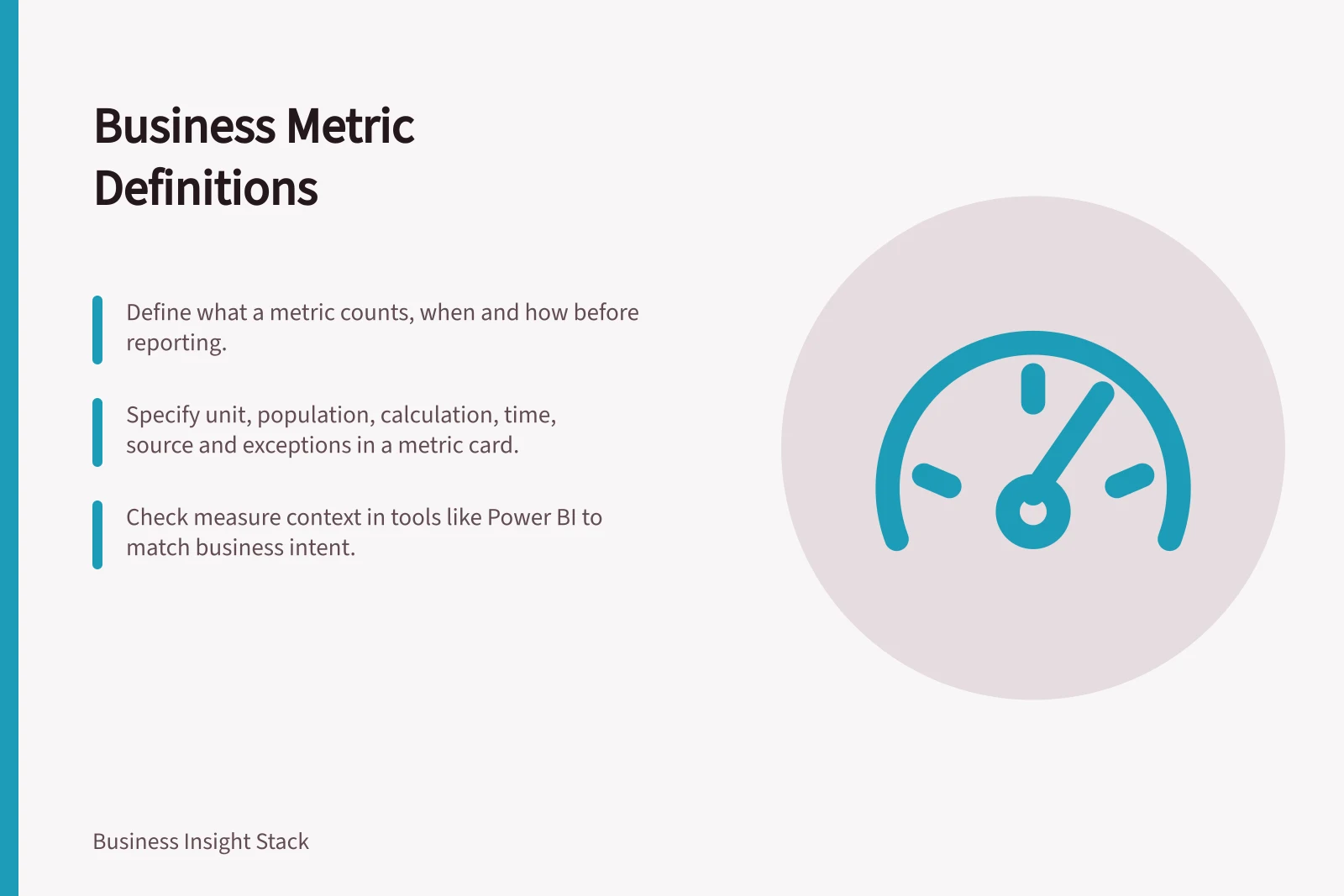
Define business metrics by purpose, population, calculation, period and owner so teams can reproduce and interpret reporting figures.
A business metric definition states what a figure counts, when it counts it and how to interpret it. Write it before the figure appears in reports. Anyone using the same name should reproduce the same result for the same population and period.
Start with the decision
Ask what someone will decide from the number. Customers who placed an order recently may matter for fulfilment planning; customers with a current contract may matter for account coverage. Both could be called “active customers”, yet they answer different questions. Give distinct measures distinct names.
Name a business owner to approve the meaning and a technical owner to implement it. The business owner settles which events and exclusions matter; the technical owner identifies available records and their limits.
Key Financial KPIs for Australian SMEs: Benchmarks and Best Practices
- 45%Gross Profit Margin (Australian SME Average)
- 1Customer Acquisition Cost (CAC) Ratio (Benchmark)
Top 5 Financial Metrics for Australian Businesses
- Net Profit MarginMeasures profitability after all expenses including GST and superannuation
- Current RatioLiquidity indicator: current assets / current liabilities
- Accounts Receivable TurnoverNumber of times receivables are collected annually
- Customer Lifetime Value (CLV)Predicts long-term value of a customer relationship
- Return on Investment (ROI)Profit relative to investment cost; critical for capital decisions
Record the rules that change the result
A compact metric card should answer these questions:
| Field | Rule to record |
|---|---|
| Purpose | Which decision or comparison uses the figure? |
| Unit | Are you counting customers, accounts, orders, events or dollars? |
| Population | Which records qualify, and which are excluded? |
| Calculation | What is counted, summed or divided, and at what level of detail? |
| Time | Which date, timezone, period boundary and data cutoff apply? |
| Source | Which records and identifiers supply the inputs? |
| Exceptions | How are refunds, cancellations, late records and missing identifiers treated? |
| Ownership | Who approves the rule and resolves a dispute? |
Add currency and display precision where relevant. For rates, document the numerator and denominator rules; see the separate numerator and denominator article.
A metric name cannot prevent a counting error. Joining an order to several order lines can repeat an order-level amount. Keep calculation rules like these with the definition.
Check what a tool's metric means
A web analytics platform reports user metrics under its own definition. That does not establish who the business considers an active customer. A site user may never have bought, and a customer may not visit during the range.
In Power BI, a measure can be evaluated under different report filters. Reusing a measure keeps a formula consistent, but its business population, date rule and intended use still need approval. Record those meanings where report authors can find them.
DAX measures support standard aggregations such as COUNT and SUM, or a formula written in the DAX formula bar.
Their results are evaluated for the context of a report cell, so an approved business meaning should be checked in the views where the measure will be used.
Using DAX Measures in Power BI: Pros and Risks
- ProsConsistent formula across reports; supports complex logic; context-aware evaluation
- ConsResults depend on report context; risk of misinterpretation without clear definitions; hidden dependencies
Make dates and accounting terms explicit
Orders placed, orders fulfilled and payments received during September can produce different figures. Show the date basis and the latest included source data, especially while a period is incomplete.
Keep recognised revenue separate from customer cash receipts. For contracts within AASB 15's scope, consult the applicable requirements for the relevant entity and transactions. Finance must approve the treatment and labels.
Review measure context
For example, Microsoft’s DAX overview uses the measure Total Sales = SUM([Sales Amount]): when Product Category is placed in a report filter, the sum is calculated for each product category. Approval can check that this behaviour matches the intended meaning, not just that the formula produces a plausible total.
A DAX formula’s tooltip can preview the result for the total in the current context. Treat that preview as one contextual result, not as proof that every report view will show the same figure.
Named DAX measures can also be used as arguments in other measures. If a definition is built on another measure, include that dependency in the approval discussion so reviewers understand which calculation is reused and what report context applies.
Review a definition before sharing it
For a proposed metric, choose a fixed period and cases that challenge its rules: a cancellation, repeated activity by one customer, a late correction and an event near the time zone boundary. Record the expected treatment of each case.
Compare the result and a useful breakdown with an agreed reference using the same population and cut-off. Investigate differences instead of changing a filter merely to make totals match.
Publish the approved meaning with its owner and known coverage limits.
In this guide
- Agreeing on one definition of active customersSet the customer unit, qualifying activity, time window and identity rule, then resolve disputed cases before sharing an active-customer count.
- Separating revenue recognition from cash receipts in dashboardsDefine recognised revenue and customer cash receipts separately, show their different dates and explain timing differences in a dashboard.
- Documenting numerator and denominator for a business KPIDefine both sides of a KPI ratio, align their population and period, and record how the rate behaves under filters and missing data.