
Metric Definitions
Part of Business metric definitions
Agreeing on one definition of active customers
Set the customer unit, qualifying activity, time window and identity rule, then resolve disputed cases before sharing an active-customer count.
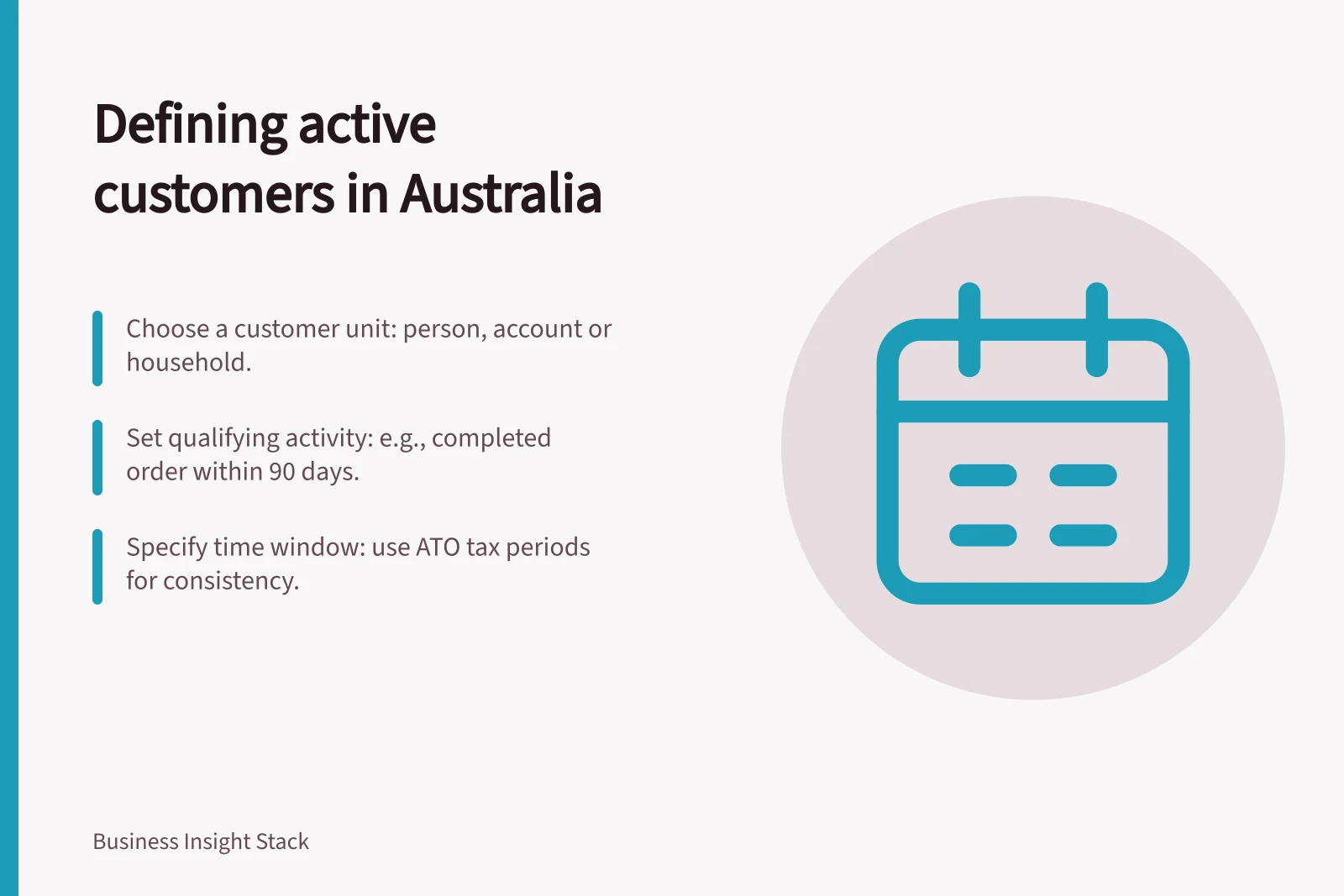
Agree on an “active customers” measure by choosing the customer unit, qualifying activity and time window for a stated decision. Test the proposed rule against records where teams disagree. If two decisions need different populations, give the measures different names.
Compare the competing meanings
Ask each team to finish the sentence, “A customer is active when…”. Sales may mean an account with an open opportunity, service one entitled to support, and operations one that placed a recent order. These are candidate measures with different uses.
Name the decision the shared figure should support. For support planning, entitlement may be relevant. For repeat-purchase analysis, a completed purchase within a defined window may be more useful. Then check whether the available records can support the chosen rule.
Competing Definitions of Active Customers Across Teams
- Sales Team
- Account with an open opportunity
- Service Team
- Customer entitled to support
- Operations Team
- Placed a recent order
Agree the counting rules
| Rule | Decision to record |
|---|---|
| Customer unit | Does one customer mean a person, account, household or another entity? |
| Eligibility | Are prospects, trial users, staff and closed accounts included? |
| Qualifying activity | Which event or state makes the customer active? |
| Window | What are its start, end, boundary rule and reporting cutoff? |
| Identity | Which identifier counts a customer once across relevant systems? |
| Corrections | How do cancellations, late records and merged accounts affect the count? |
An account with several users counts once under an account measure but may count several times under a person measure. If records across systems cannot be matched reliably, state the coverage limit. Do not present an event count as a customer count.
A digital-engagement measure may be relevant to digital engagement, but it does not determine whether a person or account satisfies your business's active-customer rule.
Agreeing on an Active Customer Definition: A Step-by-Step Process
- Define the customer unitPerson, account, household or other entity?
- Set eligibility criteriaInclude prospects, trial users, staff, closed accounts?
- Identify qualifying activityWhich event or state defines activity?
- Determine the time windowStart, end, boundary rule and reporting cutoff?
- Establish identity methodWhich identifier counts a customer once across systems?
- Define corrections policyHandle cancellations, late records, merged accounts?
Challenge the proposed rule
Have the business owner classify a small set of known cases before the calculation is finalised. Cases include a first-time purchaser, repeated qualifying events by one customer, an event at the window boundary, a cancelled transaction and an account whose identifier changed. Record both the expected result and the reason.
Suppose the proposed measure is “distinct accounts with at least one completed order in a defined window”. Multiple completed orders from one account count once. An abandoned basket does not qualify.
The owner must still decide whether a later return removes the account and specify exactly how the window's start and end are handled. This example is illustrative, not a universal definition.
For a fixed period, compare selected account IDs from the calculation with an agreed reference list. Investigate differences by status, date, identity match and missing source data. Check whether unmatched records could materially change the count.
Key Questions to Challenge the Proposed Active-Customer Rule
- Is a first-time purchaser counted?Yes, if it meets the qualifying activity within the window.
- Are multiple orders from one account counted once?Yes, under distinct account measure.
- Does an abandoned basket count?No, only completed orders qualify.
- How are returns handled?Must be defined—does a return remove the account?
- How are window boundaries treated?Must specify start and end handling (e.g., inclusive/exclusive).
Approve the name and limits
Record the full rule, owner, sources, time zone, data cut-off and known coverage gaps. Put enough meaning in the dashboard label or nearby description that readers do not mistake this count for every form of customer activity. If another team needs a contract-based count, name it separately.
When the activity rule, window or identity method changes, tell report owners whether earlier periods were recalculated. A movement in the chart may otherwise reflect a changed definition rather than changed customer behaviour.
Critical Elements for Valid Active-Customer Measurement
- Definition Owner
- Business owner or data steward
- Data Source
- Confirmed system(s) with coverage limits
- Known Coverage Gaps
- Unmatched records in legacy CRM systems


