BI Architecture
Part of Data warehouses and analytical storage
Comparing a data warehouse with operational databases
Compare operational databases and data warehouses by query workload, history, freshness and application impact before moving reports.
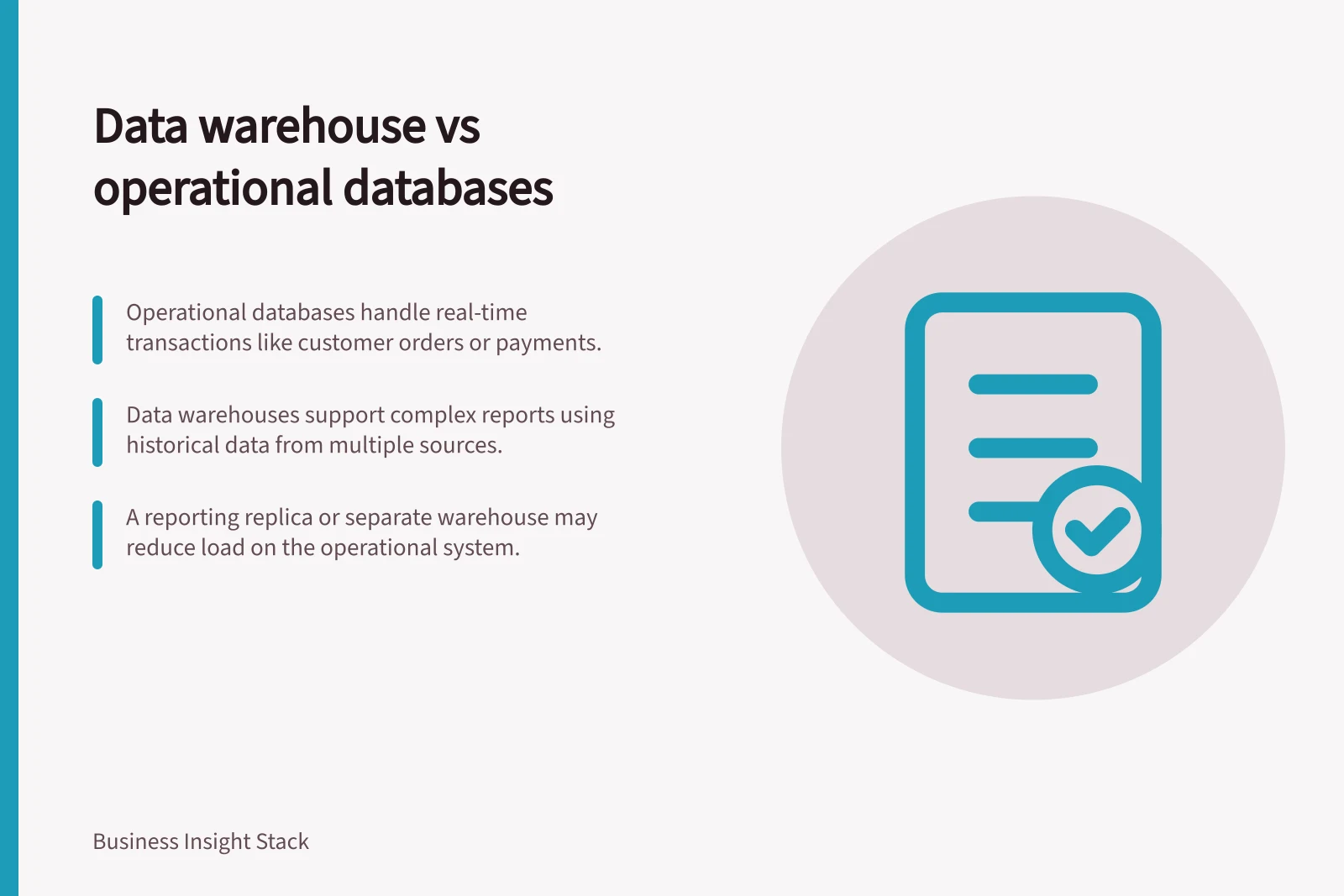
An operational database supports an application’s transactions. A data warehouse suits reporting that repeatedly needs broad scans, combined sources or history hard to serve alongside application work. Both may accept SQL, and a suitable operational database may handle modest reporting or a mixed workload. The decision rests on the reports and their effect on the application.
Compare the jobs each system serves
| Question | Operational database | Data warehouse |
|---|---|---|
| Main role | Record and retrieve business transactions. | Hold and serve data for reporting and analysis. |
| Typical query | Selective application query or individual record. | Aggregation, historical comparison or query across larger groups of records. |
| Data changes | As the application records and updates transactions. | According to the chosen ingestion and correction design; some warehouses also support direct updates. |
| Reporting context | Application state and transaction rules. | Source cutoff, included history and reporting definitions. |
These are typical roles, not exclusive capabilities. Microsoft’s architecture guidance recognises mixed transactional and analytical workloads; its Fabric guidance describes SQL databases that support both. Check what a particular deployment can do under the workloads that will actually overlap.
Operational Database vs Data Warehouse: Key Differences
- Main roleRecord and retrieve business transactions.
- Typical querySelective application query or individual record.
- Data changesAs the application records and updates transactions.
- Reporting contextApplication state and transaction rules.
- Main roleHold and serve data for reporting and analysis.
- Typical queryAggregation, historical comparison or query across larger groups of records.
- Data changesAccording to the chosen ingestion and correction design; some warehouses also support direct updates.
- Reporting contextSource cutoff, included history and reporting definitions.
Measure pressure on the operational system
List reports that query the application database. Capture their filters, tables, time ranges, schedules and overlap with application activity. Ask the database owner which queries already compete with important writes. A weekly aggregate may be acceptable; repeated wide scans at a busy time may justify a separate reporting path.
A reporting replica is another possible path if the database setup supports one. Check its freshness, operating cost and reporting capacity. A replica alone does not supply definitions across systems or history the application no longer retains.
Key Considerations When Evaluating Reporting Workloads
- Report frequencyWeekly aggregates may be acceptable; repeated wide scans during peak times may require a separate path.
- Replica freshnessCheck how up-to-date the reporting replica is.
- Operating costConsider the cost of maintaining a replica or warehouse.
- Reporting capacityEnsure the replica can handle concurrent reporting workloads.
Check what a warehouse adds
Moving queries to a warehouse creates data movement and reconciliation work. Specify when records arrive, how updates and deletions appear, how late corrections change earlier periods and what a report shows before a load completes. A figure loaded yesterday should not be presented as a live operational count.
For example, a service application might answer, “What is this case’s status now?” A monthly report might ask how open cases changed by team over the past year. If the application lacks the needed history or the query disrupts its normal work, an analytical copy may help. The team must still agree which status and date count for each month.
Pros and Cons of Using a Data Warehouse for Reporting
- ProsSeparate resources reduce pressure on operational systems; retains historical data; supports complex cross-source analysis.
- ConsIntroduces data movement and reconciliation work; requires agreement on definitions (e.g., which status counts for a month); may show delayed data, not real-time.
Decide with a representative report
Choose a fixed period and reproduce one important figure through each viable route. Compare the result, data cut-off, query time under representative load, application impact and maintenance effort. Resolve differences in data or definitions before comparing speed. Keep reporting on the operational route if it meets the agreed need; use a warehouse when separate resources, retained history or combined data solve a demonstrated problem.